
Updated: October 17, 2026
Most SEO forecasting tool comparisons rank every product highly and recommend whichever one pays the biggest affiliate commission. This one is organised around a more useful question: what are you actually trying to decide, and do you need to spend money to decide it?
Because for a lot of businesses, the honest answer is no.
An SEO forecasting tool projects future organic traffic and revenue by applying click-through-rate curves to keyword search volume at target ranking positions. The best choice depends on scale: agencies managing many clients need a platform, while a single business with Search Console access can usually forecast accurately in a spreadsheet for free.
Quick Picks: The Best SEO Forecasting Tool by Use Case
| If you are | Start with | Why |
|---|---|---|
| A small business with existing traffic | Google Search Console + a spreadsheet | Free, uses your own data, accurate enough for a real decision |
| An agency managing multiple clients | A platform with white-label reporting | Per-client dashboards and presentable output justify the cost |
| An in-house team at an established site | Your existing SEO platform’s forecast module | You are probably already paying for it |
| Forecasting a site with no traffic history | A keyword-volume-based tool | No baseline exists, so keyword modeling is the only option |
| Enterprise with analyst support | A dedicated forecasting platform | Scenario modeling and API access earn their keep at scale |
What an SEO Forecasting Tool Actually Does
Every tool in this category runs the same underlying calculation: search volume multiplied by expected click-through rate at a target position, phased over a ramp period, then converted to revenue using your conversion rate.
What you pay for is not the math. It is the data, the automation, the competitor benchmarking and the reporting.
That distinction matters, because if you understand the model you can run it yourself. We cover the full method, including how to build your own CTR curve and model a realistic ramp, in our guide to SEO forecasting. Read that first if you want to understand what the tool is doing on your behalf.
How to Evaluate an SEO Forecasting Tool: 6 Criteria
Most reviews grade general SEO platforms and mention forecasting in passing. Judge the forecasting module on its own terms.
1. Does it use your first-party data? A tool that forecasts purely from third-party volume estimates will be less accurate than one that ingests your Google Search Console history. Search Console integration is the single highest-value feature in this category.
2. Can you edit the assumptions? If you cannot change the target position, the CTR curve or the ramp, you have a calculator, not a forecasting tool. Locked assumptions are a serious limitation.
3. Does it produce scenarios or one number? Conservative, expected and aggressive cases are the difference between a model and a promise. A tool that outputs a single figure is encouraging you to over-commit.
4. Does it account for SERP features? AI Overviews, map packs and shopping carousels all reduce organic click share. A tool still using pre-2024 CTR assumptions will over-forecast on informational queries.
5. Is the output presentable? For agencies this is most of the value. White-label reports and client-ready charts save real hours.
6. Does it track forecast against actuals? Forecasting is iterative. A tool that never compares its predictions to reality cannot improve, and neither can you.
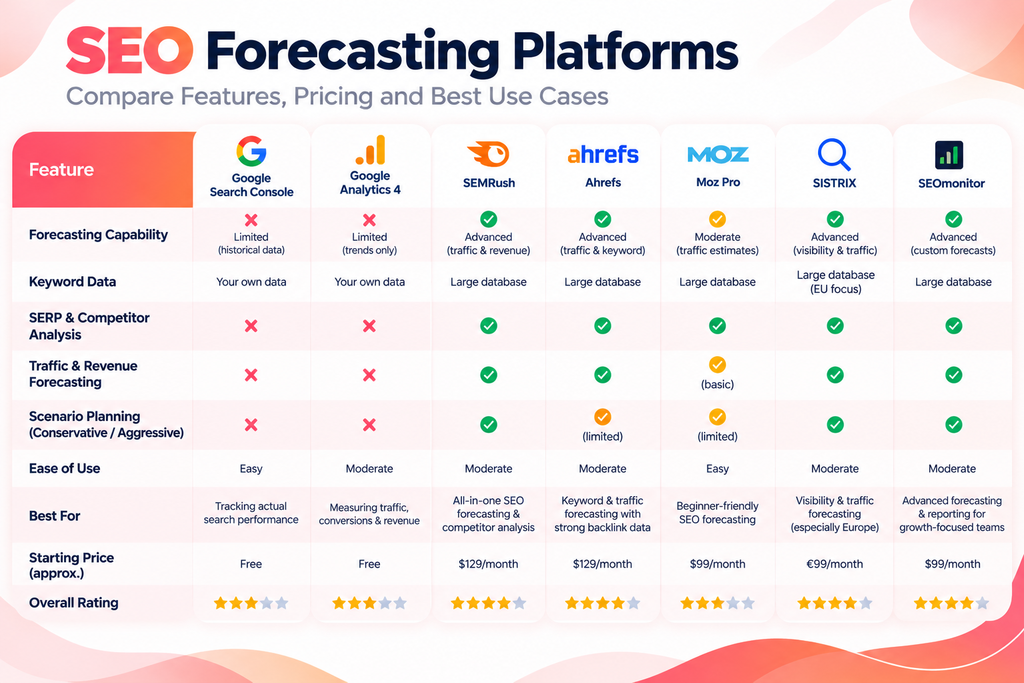
Best SEO Forecasting Tools Compared
| Tool | Best for | Forecast type | Free option | Pricing from |
|---|---|---|---|---|
| Semrush | Enterprise and agencies | Keyword, traffic and ROI | Trial | $117.33/mo |
| Ahrefs | Traffic potential estimates | Traffic potential metric | Limited | $129/mo |
| SE Ranking | SMBs and growing agencies | Keyword and rank progression | Trial | $103.20/mo |
| BrightEdge | Dedicated forecasting | Scenario modeling | Demo | Custom |
| Moz Pro | New site owners | Keyword priority modeling | Trial | $99/mo |
| Google Search Console + Sheets | Budget-conscious teams | Historical trend plus keyword model | Free | $0 |
The Best Free SEO Forecasting Tool Options
“seo forecasting tool free” and related phrases draw steady volume, and the free route is genuinely viable for most single-site businesses.
Google Search Console plus a spreadsheet. Export 16 months of query data, derive your own CTR curve by position band, and model forward. This is the most credible free option because it uses your real performance data rather than industry averages. The only cost is a couple of hours.
Free tiers of paid keyword tools. Enough volume data to seed a manual model, usually with daily query limits.
Google Trends. Free seasonality data to adjust monthly projections, which most paid tools charge for.
The honest summary: a free setup gets a single business to roughly the same answer as a paid one. What you lose is competitor benchmarking, automation and client-ready reporting. If none of those matter to you, keep your money.
Best SEO Forecasting Tools for Agencies
Agencies are buying workflow, not math. The features that matter:
- White-label reporting so the output carries your brand
- Multi-client dashboards so forecasts live in one place
- Presentation-ready exports for pitches and QBRs
- Scenario modeling so you can show a conservative case and manage expectations
- Forecast versus actual tracking so month nine is a review, not an argument
A note from experience: the forecast you show in a pitch sets the expectation you are judged against for the next year. A tool that makes optimistic numbers easy to generate is a liability, not a feature.
Best SEO Forecasting Tools for Small Businesses
Priorities invert here. You need something you can operate without an analyst.
- Setup time under an afternoon
- Clear revenue output, not just sessions
- Your own conversion data, since industry benchmarks will mislead you
- Low or no cost, because the forecast should not be a meaningful line item
For most small businesses, the spreadsheet route is the right answer, and a paid platform becomes worthwhile around the point where you are managing several sites or reporting to someone who needs formal documentation.
When You Do Not Need an SEO Forecasting Tool
No other guide in this category will tell you this, so here it is.
Skip the purchase if:
- You run one website and already have Search Console data. A spreadsheet will do.
- Your SEO budget is under roughly $1,000 a month. Tool cost would consume a meaningful share of the work itself.
- You need the forecast once, for one decision. Build it manually.
- Nobody will read the output except you. White-label reporting is worthless to an audience of one.
- You have no reliable conversion rate yet. Fix measurement first, because a revenue forecast on a guessed conversion rate is worse than no forecast.
Buy one if:
- You forecast for multiple clients or multiple sites
- You need competitor traffic projections, which genuinely require third-party data
- You report to a finance team that expects formal, repeatable documentation
- You are forecasting at programmatic scale across hundreds of pages
How Accurate Are SEO Forecasting Tools?
Accuracy depends far more on your assumptions than on your software. A well-built spreadsheet using your own Search Console CTR data will beat an expensive platform running generic curves.
Three things degrade accuracy regardless of what you paid:
Search volume is modeled, not measured. Tools estimate it from sampled data, and figures differ between providers for the same keyword.
Generic CTR curves do not match SERPs with AI Overviews. Where an AI Overview appears, organic click-through rates fall substantially. [VERIFY: cite a current study with its publication date, and check how it defines the measurement, before stating any figure] If your target keywords are informational, a tool using older curves will systematically over-forecast.
Nobody updates the model. The strongest accuracy gain available is also free: compare forecast to actual every quarter and correct the assumptions that proved wrong.
Treat any forecast as a range. Present the conservative case alongside the expected one. Our SEO forecasting guide covers how to build that range and how to audit a forecast somebody hands you.
Frequently Asked Questions
What is an SEO forecasting tool?
An SEO forecasting tool is software, or a structured spreadsheet model, that projects future organic traffic and revenue using keyword search volume, click-through-rate curves by position, and your historical performance data. It converts a ranking goal into an expected traffic and revenue figure you can plan against.
What is the best free SEO forecasting tool?
Google Search Console paired with a spreadsheet is the strongest free option for any site with traffic history, because it uses your own click-through-rate data instead of industry averages. Several paid platforms also offer free tiers with enough keyword volume data to build a manual model.
Do I actually need to pay for an SEO forecasting tool?
Often not. If you run a single website and have Search Console access, a spreadsheet will get you to the same decision. Paid tools earn their cost when you forecast for multiple clients or sites, need competitor traffic projections, or require white-label reporting for stakeholders.
Which SEO forecasting tool is best for agencies?
Look for white-label reporting, multi-client dashboards, editable assumptions and scenario modeling. The specific platform matters less than whether it lets you present a conservative case, because the forecast you show in a pitch becomes the expectation you are measured against.
How accurate are SEO forecasting tools?
Accuracy is driven by assumptions rather than software. Tools using your own Search Console data and conservative position targets perform meaningfully better than those applying generic click-through-rate curves. Always present a range rather than a single number, and compare forecast to actual each quarter.
How do AI Overviews affect SEO forecasting tools?
Where an AI Overview appears, organic click-through rates fall, so any tool applying pre-2024 CTR curves will over-forecast on informational queries. Check whether a tool updates its CTR assumptions for SERP features, and whether it tracks AI visibility as a separate metric.
The Takeaway
The best SEO forecasting tool is whichever one gets you to a defensible number you will actually revisit. For many businesses that is a spreadsheet and a free Search Console export. For agencies and multi-site teams, a platform pays for itself in reporting time alone.
Whatever you choose, the tool is not what makes a forecast credible. Visible assumptions, a conservative case and a quarterly review are.
If you would rather have a forecast built on your own data, with the assumptions written down and a conservative case included, get in touch with Web Marlins. We will walk you through the model, not just the output.

Amir Siddiqui is a Digital Marketing Expert and SEO Specialist with over 8 years of experience helping businesses grow through data-driven digital marketing strategies. As the Founder of Web Marlins Pvt. Ltd., his core expertise lies in Search Engine Optimization (SEO), including Technical SEO, Local SEO, AI SEO, and content strategy. He has helped businesses across India, the USA, and the UAE improve search rankings, increase organic traffic, and generate high-quality leads through sustainable, results-focused SEO solutions.