
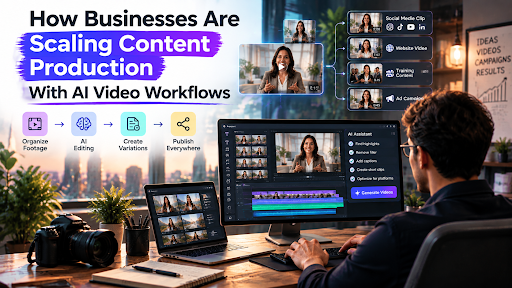
Updated: September 25, 2026
Video has become one of the most important formats for businesses looking to attract audiences, explain products, and build stronger digital presence. From social media campaigns to customer education and brand storytelling, companies are producing more video content than ever before.
However, creating video content at scale is not always easy. Businesses often face challenges such as limited resources, long editing timelines, and the repetitive work required to transform raw footage into finished videos.
Reviewing recordings, selecting clips, removing unnecessary sections, improving audio, and creating multiple versions can take hours. For marketing teams that need to publish content consistently, these tasks can slow down the entire production process.
AI-powered video workflows are changing how businesses approach content creation. Instead of relying only on manual editing processes, companies are using AI tools to automate repetitive tasks while allowing teams to maintain control over the final output.
Why Businesses Need Faster Video Production Workflows
The demand for video content continues to increase across industries.
Businesses use videos for:
- Product demonstrations
- Social media campaigns
- Training materials
- Customer testimonials
- Advertisements
- Internal communication
The challenge is that producing more content usually requires more time and resources.
Traditional video production involves multiple stages:
- Planning the content
- Recording footage
- Reviewing material
- Selecting the best clips
- Editing sequences
- Adding visual elements
- Creating different versions
While each step is important, many of these tasks involve repetitive work that can take valuable time away from creative planning.
This is where AI video workflows help businesses improve efficiency.
What Are AI Video Workflows?
AI video workflows use artificial intelligence to assist with different stages of video production.
Instead of manually completing every editing task, businesses can use AI-powered tools to support processes such as:
- Organizing footage
- Identifying useful clips
- Creating initial edits
- Improving video quality
- Generating content variations
The goal is not to remove human creativity from video production. Instead, AI helps teams handle time-consuming tasks faster so they can focus on storytelling, strategy, and audience engagement.
How AI Video Editors Help Businesses Create Content Faster
Modern AI video editors are designed to simplify the editing process by helping users move from raw footage to completed videos more efficiently.
For example, businesses working with interviews, webinars, product recordings, or social media footage often need to review large amounts of content before creating the final version.
AI-assisted workflows can help identify important moments, remove unnecessary sections, and create a structured starting point for editors to refine.
Invideo Editor supports this approach by combining AI assistance with a professional editing workflow. Businesses can use AI capabilities to reduce repetitive editing tasks while still maintaining control over the final project.
Using AI to Improve Content Production at Scale
Scaling video production requires more than creating a single video. Businesses often need multiple versions of content for different audiences and platforms.
A single recording may need to become:
- A long-form website video
- Short social media clips
- Marketing campaign assets
- Training materials
- Customer communication videos
Managing these variations manually can increase production time.
AI video workflows help teams adapt existing content more efficiently. By automating repetitive editing steps, businesses can create more content without increasing the workload on their creative teams.
Choosing the Right AI Video Editing Approach
Different businesses have different content needs. The right AI video workflow depends on the type of content being created and the level of control required.
For teams that want to speed up production while keeping flexibility, Invideo Editor provides a workflow where users can create videos faster by editing videos with AI while still switching to the timeline when they need more control.
This type of workflow is useful for businesses that want AI assistance with repetitive editing tasks but still want the ability to review, adjust, and refine the final result.
Read Also: Invideo Editor vs CapCut: Which AI Video Tool Fits Businesses Better?
Benefits of AI Video Workflows for Businesses
Reduced Production Time
AI tools can help reduce the amount of time spent on repetitive editing tasks, allowing teams to focus on content strategy.
More Consistent Content Creation
Businesses can maintain a regular publishing schedule by simplifying the process of creating multiple videos.
Better Use of Existing Content
Companies can transform existing recordings into different formats instead of creating every piece of content from scratch.
Improved Team Efficiency
Marketing teams can produce more content without requiring every project to go through a complex production process.
The Future of Business Content Creation
AI video workflows are becoming an important part of modern marketing strategies. As businesses continue to increase their use of video content, the ability to create, edit, and distribute videos efficiently will become increasingly valuable.
The future of video production will likely combine human creativity with AI-powered assistance. Businesses will continue to control their messaging and creative direction while AI tools help manage repetitive operational tasks.
Invideo Editor represents this shift by helping businesses create videos through a workflow that balances automation with creative control.
Conclusion
Businesses no longer need large production teams to create effective video content. With AI-powered workflows, companies can simplify editing processes, produce more content, and improve how they communicate with their audiences.
The key is finding a workflow that supports both efficiency and creativity. By combining human decision-making with AI assistance, businesses can scale their video production while maintaining quality and consistency.

Amir Siddiqui is a Digital Marketing Expert and SEO Specialist with over 8 years of experience helping businesses grow through data-driven digital marketing strategies. As the Founder of Web Marlins Pvt. Ltd., his core expertise lies in Search Engine Optimization (SEO), including Technical SEO, Local SEO, AI SEO, and content strategy. He has helped businesses across India, the USA, and the UAE improve search rankings, increase organic traffic, and generate high-quality leads through sustainable, results-focused SEO solutions.