
Updated: October 20, 2026
A strong competitor analysis can reveal far more valuable insights. If the analysis is performed using the right metrics, you can easily understand how strong competitors are, where they are gaining visibility, attracting traffic, and building connections with the audience.
These insights can help you identify gaps in your own SEO strategy while also uncovering opportunities for potential improvement.
Let’s discuss six important metrics in detail.
6 Important Metrics to Track When Analyzing Competitors
Here are a few important metrics to track when analyzing your competitors’ websites.
1. Keyword Rankings
Tracking keyword rankings will help you understand how the competitors are gaining more and more visibility in search engine results. By analyzing the keywords your competitors rank for (especially those with significant search volume), you can identify the topics, search queries, and even products that are driving the most visitors on the competitor site.
Wondering how to track this? Well, the approach is simple and straightforward.
Pick a specialized SEO tool such as SEMrush and start tracking keyword positioning.
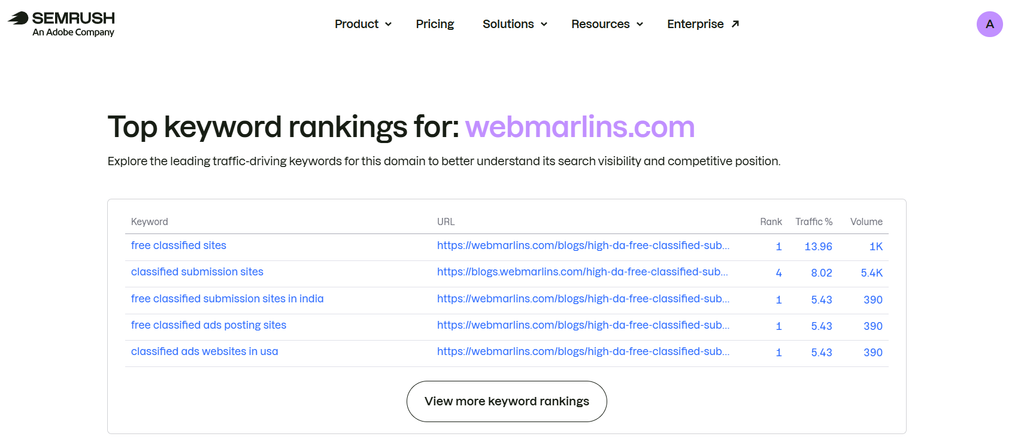
Source: https://www.semrush.com/free-tools/keyword-rank-checker/
While reviewing keywords provided by the tool, you need to look at the terms on which competitors consistently rank in prominent search positions. Also pay special attention to the search intent behind these keywords and the pages that competitors use to target them.
The most effective approach is comparing your own keyword rankings with those of competitors. If a competitor ranks well for a relevant keyword that your site does not target effectively, this may indicate an opportunity to review your strategy.
2. Organic Traffic
Organic traffic is another important metric to track when benchmarking competitors. This metric refers to the measure of how many visitors arrive on a competing website through unpaid search results.
You can use numerous advanced tools such as Ahrefs Traffic Checker to estimate the organic search traffic of a website or specific webpage over the past few months. It also mentions top-traffic pages as well. A screenshot is also attached below for a better understanding.
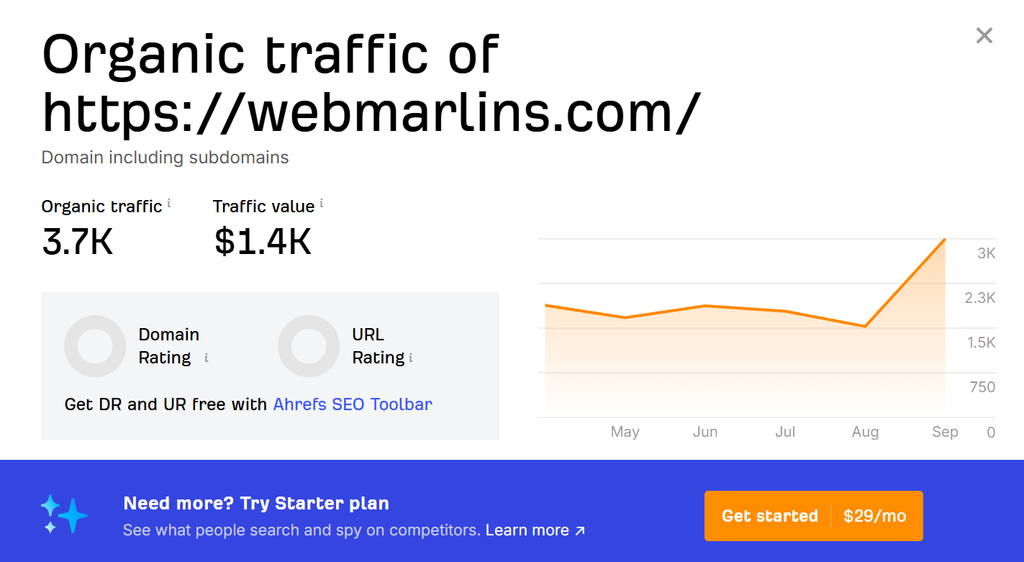
Source: https://ahrefs.com/traffic-checker/
When analyzing organic traffic, do not focus only on the single figure mentioned by the tool. Instead, thoroughly review the traffic trends for the past few months and examine which pages contribute most to a competitor’s organic traffic. This can provide additional context about the competitor’s search performance.
Monitoring organic traffic can also help you understand the overall competition within the target industry. For example, if multiple competitors’ websites are receiving a significant amount of traffic consistently on a particular topic, then this may indicate strong demand for that subject.
3. Backlink Profile
A backlink profile refers to the total number of backlinks that a website is receiving from other sources. Tracking the backlink profile of competitors can provide valuable information about how they have built authority over time by acquiring links from relevant and credible sources.
Use tools like Majestic to quickly perform a thorough backlink profile audit of any site. It provides a list of backlinks along with numerous valuable insights.
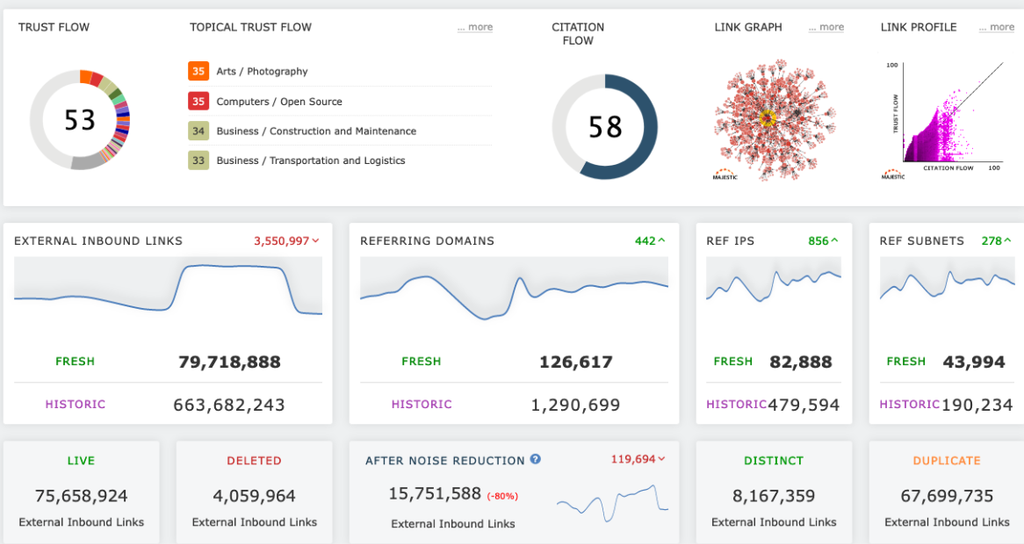
Source: https://majestic.com/
When the tool has performed the audit, start by identifying the websites that frequently link to competing businesses. These may include:
- Publications
- Journals
- Blogs
- Directories
- News websites
Next, start examining why those websites are linked to your competitor. During this, you may come across different reasons such as quality content, citing credible sources, and more. If multiple competitors have backlinks from the same source, it may be worth exploring that site for your own backlink strategy.
Avoid blindly following the footsteps of competitors’ backlink strategy. Use their backlink profile with other factors to decide whether it is worth pursuing link collaboration with a y
- Niche relevance
- Topical authority
- Content quality
4. Domain Authority Score
Domain authority (DA) is a third-party SEO metric. It is measured on a scale of 1 to 100 and used to estimate a website’s credibility, authority, and ranking potential in the SERPs. A higher score generally indicates greater comparative ranking potential.
Comparing the DA scores of competing sites provides a quick way to assess their relative authority compared with your own website. If many competitors have considerably strong domain authority scores, then this may indicate tough competition in the target industry/niche, and you will need top-tier content and a strong backlink profile to actually succeed.
On the internet, you can easily find many domain authority checkers that allow you to check a domain’s DA score. A screenshot of one such tool is attached below.
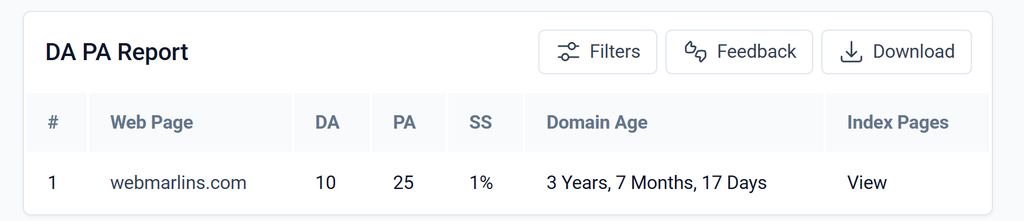
Source: https://www.prepostseo.com/domain-authority-checker
It is important to note that domain authority is not officially recognized as an SEO metric by Google. Still, it is widely acknowledged and used by SEO professionals to quickly assess the authority and credibility of websites.
5. Top-Performing Pages
Tracking the top-performing pages of a competitor’s website can reveal which topics are driving more traffic and visibility for them. You can then determine whether your site is actually covering those topics.
In simple words, analyzing top-performing pages allows you to move beyond analyzing entire websites and examine the specific pages that contribute significantly to a competitor’s organic traffic and visibility. You can use Ahrefs Site Explorer to quickly extract such data about any website.
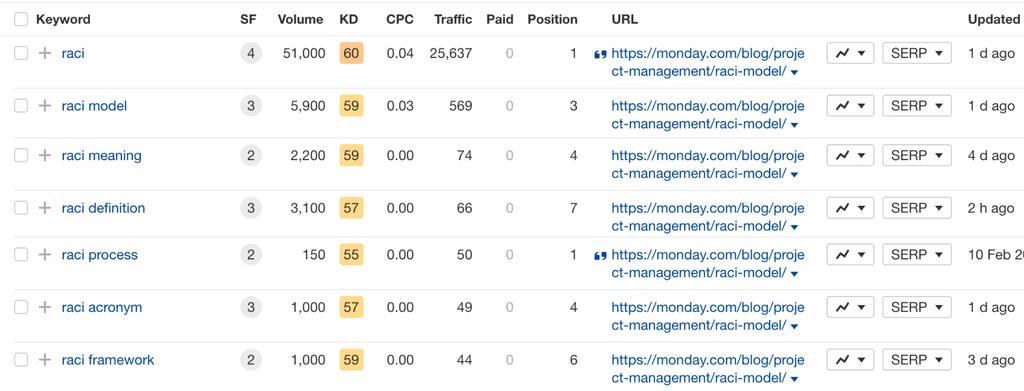
When you have the top-performing pages, here is what to do:
- First, identify the pages that are receiving the most organic traffic and also ranking for relevant keywords.
- Next, analyze what makes those pages valuable from both a search engine and user perspective. Consider search intent, message delivery, and internal and external linking.
If you have also covered content similar to those pages, then compare them as well. Doing so will help you identify gaps and areas of improvement within your content and overall content creation strategy.
6. Technical SEO and Page Experience
By tracking technical performance, you can easily understand how well competitors’ websites are built to deliver a seamless browsing experience to visitors. To monitor this metric, there are multiple factors that you need to look for:
- Loading speed: Website loading speed is a ranking factor and refers to how quickly the site loads in front of users. Usually, a page should load in under 2 seconds. Tools like GTmetrix can help evaluate site speed.
- Mobile responsiveness: It is a web design approach that allows a website to change its layout, text, and pictures according to the screen size of the device on which it is being opened. You can easily find a number of free tools online to measure the mobile responsiveness of any site.
- Site structure: This refers to the organization of information, web elements, pages, and content on a website. The clearer a site’s structure is, the easier it is for users and search engines to navigate.
- Broken links: These are links that lead to unavailable, broken, or incorrect destinations.
It is recommended to compare both your own and competitor websites in the context of these technical metrics. This way, you can identify weaknesses of both sites.
Wrapping It Up
Regularly analyzing competitor websites is one of the most popular and useful strategies. It helps reveal insights into the latest strategies, trends, and even areas of improvement within your own site. However, these benefits can only be availed when you are using the right metrics to benchmark competitors. In this blog post, we have discussed six important factors that you should consider.

Amir Siddiqui is a Digital Marketing Expert and SEO Specialist with over 8 years of experience helping businesses grow through data-driven digital marketing strategies. As the Founder of Web Marlins Pvt. Ltd., his core expertise lies in Search Engine Optimization (SEO), including Technical SEO, Local SEO, AI SEO, and content strategy. He has helped businesses across India, the USA, and the UAE improve search rankings, increase organic traffic, and generate high-quality leads through sustainable, results-focused SEO solutions.