
Updated: October 17, 2026
You are holding a proposal that promises 40,000 monthly visitors in twelve months. It has a nice chart. The line goes up and to the right. And you have no idea whether that number is a careful projection or something typed into a slide the night before the pitch.
That is the real problem with SEO forecasting. Not the math. The math is simple enough to run in a spreadsheet. The problem is that most forecasts hide their assumptions, and a forecast without visible assumptions is just a confident-sounding guess.
This guide covers both sides. How to build an organic traffic forecast you can defend, and how to pull apart one somebody hands you.
SEO forecasting is the process of estimating future organic traffic and revenue by multiplying keyword search volume by the expected click-through rate at a target ranking position, then phasing those gains across a realistic ramp period. It turns SEO from an open-ended expense into a plan with numbers attached.
What SEO Forecasting Actually Is (And What It Is Not)
A forecast is a model of what happens if a set of assumptions holds. Change an assumption and the number changes. That is a feature, not a weakness, because it lets you test decisions before you spend money on them.
What a forecast can tell you
- Roughly how much organic traffic a set of keywords could produce at a given ranking position
- What that traffic is worth once you apply your conversion rate and order value
- Whether a proposed SEO budget has any chance of paying for itself
- Which keyword groups deserve your money first
- What you would have to believe for the optimistic case to come true
What no forecast can tell you
- Exactly what you will rank for, or exactly when
- What Google will change next
- What your competitors will do in response
- What AI Overviews will do to click-through rates on your terms next quarter
Anybody who presents an SEO forecast as a prediction rather than a model is either inexperienced or selling. The useful version of this exercise produces a range with stated assumptions, not a single confident number.
Why SEO Forecasting Matters for Business Owners
SEO has a trust problem, and it is mostly a measurement problem. You spend for months before anything moves, and by the time results arrive, nobody remembers what was promised.
A forecast fixes three specific things.
It makes the decision comparable. You can put projected SEO return next to paid search, paid social, or hiring a salesperson, and compare them on the same terms.
It sets the argument up front. When everyone agrees in month one on what success looks like in month nine, month nine stops being a fight.
It exposes bad proposals early. Once you understand the formula, an inflated projection becomes obvious in about ten minutes.
The Core SEO Forecasting Formula
Every traffic forecasting SEO model, from a free spreadsheet to enterprise software, runs on the same basic equation:
Projected traffic = Search volume × CTR at target position × Probability of reaching that position
Then you phase it over time and convert to revenue. Here is how to run each step.
Step 1: Build your keyword universe
List the keywords you realistically want to compete for. Pull them from Search Console (terms where you already get impressions but weak clicks are the fastest wins), from a keyword tool, and from the questions your sales team hears.
Group them. A forecast built keyword by keyword gets unwieldy fast, and it also misunderstands how pages work. One page ranks for dozens of related terms, not one.
Pro Tip: Separate branded from non-branded keywords before you start. Branded traffic would arrive anyway. Including it in an SEO forecast inflates the result and is one of the most common ways proposals mislead.
Step 2: Set realistic target positions
This is the step where forecasts go wrong most often.
Be honest about where you can get to. If you are a new site competing against established national players, position three is not a twelve-month target. Look at the current top ten for each keyword group and ask whether you can plausibly build something better than what is there.
A reasonable approach: assign each keyword group a target position band rather than an exact number. Positions 1 to 3, 4 to 6, 7 to 10. Then run the forecast on the band.
Step 3: Apply a CTR curve, preferably your own
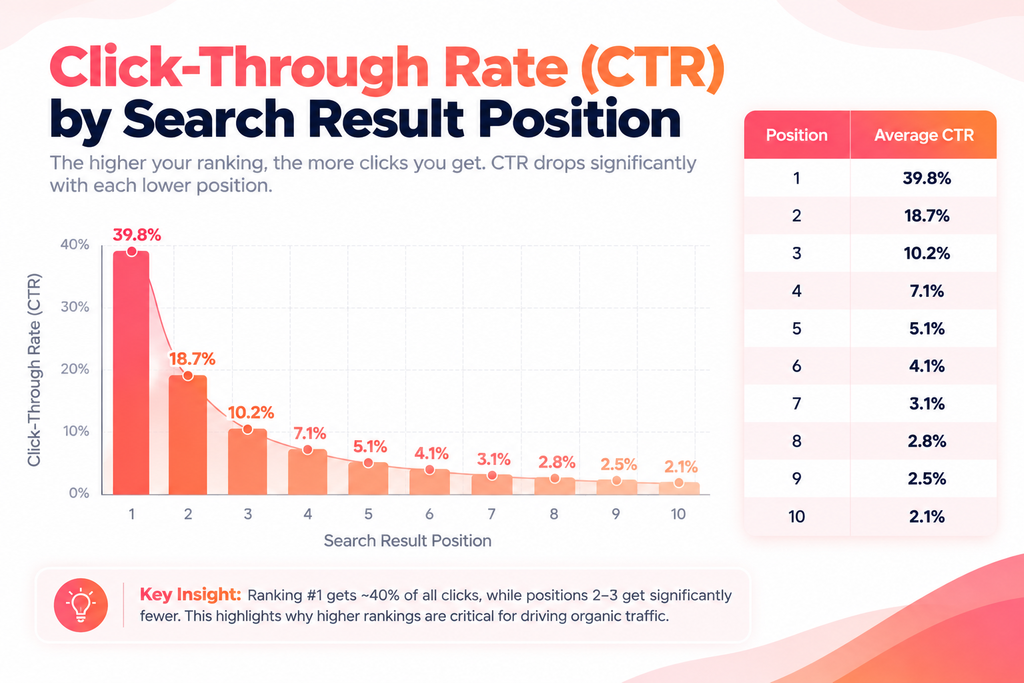
Click-through rate falls sharply with position. Generic CTR curves are published all over the web, and they are fine as a starting point, but they are averages across wildly different query types.
The better move: build your own curve from Google Search Console. Export your query data with average position and CTR, group by position band, and calculate your real average CTR at each band. That is a first-party number specific to your industry and your SERP layout, and it instantly makes your forecast more defensible than one built on a borrowed table.
This matters more than it used to. On queries where an AI Overview appears, organic click-through rates have fallen significantly, and the effect varies by query type and industry. If a meaningful share of your target keywords trigger AI Overviews, a forecast using 2021-era CTR assumptions will be too optimistic.
Step 4: Model the ramp
A forecast that shows full traffic in month one is wrong. SEO compounds slowly.
Phase your projected gains across the forecast period. A workable default for a small to mid-sized site:
| Period | Share of projected gain realized |
|---|---|
| Months 1 to 3 | 0 to 10% |
| Months 4 to 6 | 20 to 35% |
| Months 7 to 9 | 50 to 70% |
| Months 10 to 12 | 80 to 100% |
Adjust for your situation. An established site adding content to an existing topic cluster moves faster. A brand new domain moves slower, sometimes much slower.
The ramp is also the single most useful thing to hand a nervous stakeholder. It tells them what “on track” looks like in month four, so nobody panics.
Step 5: Convert traffic to revenue
Traffic is not the point. Run it through to money:
Projected revenue = Projected organic traffic × Conversion rate × Average order value (or average lead value)
Use your own conversion rate from analytics, not an industry benchmark. If you sell services rather than products, use closed deal value multiplied by your lead-to-close rate.
If you do not have a reliable conversion rate yet, say so and present the forecast as traffic only. A revenue forecast built on a guessed conversion rate is worse than no revenue forecast at all.
A Worked Example: Forecasting SEO Growth for a Small Business
Here is the whole model on one page. The inputs below are illustrative, chosen to show the mechanics. Replace every one with your own data.
A regional B2B services company targets four keyword groups.
| Keyword group | Combined monthly volume | Target position band | Assumed CTR | Projected monthly clicks |
|---|---|---|---|---|
| Core service terms | 2,400 | 4 to 6 | 6% | 144 |
| Location + service | 1,800 | 1 to 3 | 15% | 270 |
| Problem and symptom queries | 3,200 | 7 to 10 | 2.5% | 80 |
| Comparison and “best” queries | 900 | 4 to 6 | 6% | 54 |
| Total | 8,300 | 548 |
So the twelve-month target is roughly 548 additional monthly organic visits, reached gradually.
Now the money. Assume a 2.5% visitor-to-lead rate, a 20% lead-to-client rate, and $3,000 average client value:
- 548 visits × 2.5% = 13.7 leads per month
- 13.7 leads × 20% = 2.7 new clients per month
- 2.7 × $3,000 = roughly $8,100 per month in new revenue at full ramp
Against an SEO investment of, say, $2,500 per month, that is a defensible case. And now the conversation is about which assumption you disagree with, which is a far more productive argument than “is SEO worth it.”
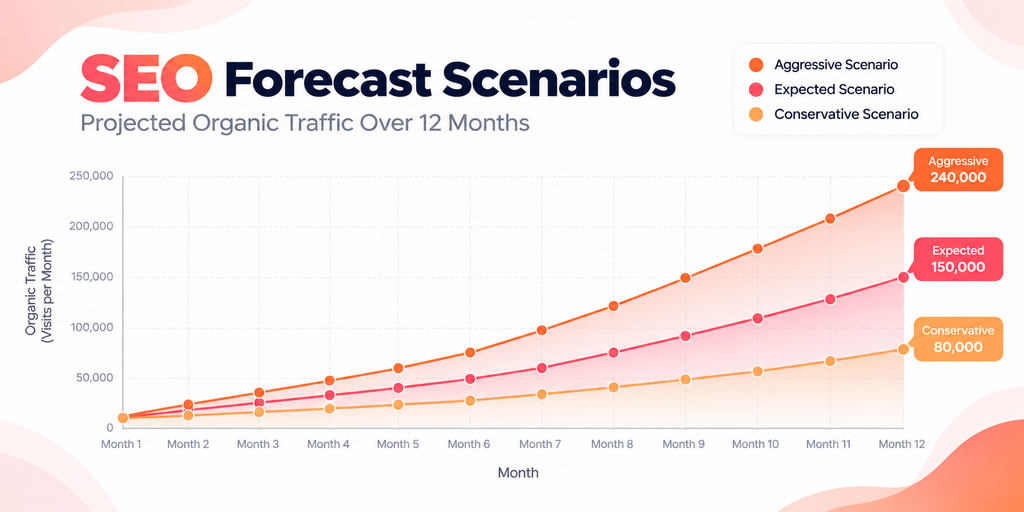
Build three versions. Run the same model with pessimistic, expected and optimistic position targets. Present the range. A single number invites someone to treat it as a promise.
SEO Forecasting Methods Compared
There is more than one way to forecast SEO, and they suit different situations.
| Method | How it works | Best for | Weakness |
|---|---|---|---|
| Keyword-based | Volume × CTR at target position | New sites, new content plans, agency proposals | Ignores keywords you did not list |
| Historical trend | Project your past traffic curve forward | Established sites with 2+ years of stable data | Assumes the past repeats; blind to strategy changes |
| Time series modeling | Statistical models applied to historical data | Larger sites, teams with analyst support | Needs technical skill; still blind to competitor moves |
| Competitive gap | Model what a competitor’s traffic implies is available | Entering a known market | Depends on third-party traffic estimates |
| Blended | Historical baseline plus keyword-based upside | Most real businesses | Takes longer to build |
For most business owners the honest answer is blended: take what your site does now, then add modeled upside from the specific keyword groups you plan to target. Forecasting the upside alone, with no baseline, is how proposals end up fantastical.
How to Forecast Organic Traffic Without Expensive Tools
You do not need enterprise software for this. You need Google Search Console, a spreadsheet, and roughly two hours.
- Export 12 months of Search Console query data. This is your baseline and your CTR source, and it is free.
- Pull search volumes for your target keyword groups from any keyword tool, including the free tiers.
- Build your own CTR curve from the Search Console export, grouped by position band.
- Set target position bands by looking at who currently ranks and judging honestly.
- Build the ramp across your forecast months.
- Layer in conversion rate and value from your analytics.
- Run it three times for conservative, expected and aggressive cases.
Paid forecasting tools mostly automate steps 2 through 5 and add competitor data. Useful at scale, not required to make a good decision.
Why SEO Forecasts Miss (And How to Make Yours More Accurate)
Forecasts miss for predictable reasons. Most of them are fixable.
Search volume is an estimate, not a measurement. Keyword tools model volume from sampled data, and figures differ between tools for the same keyword. Treat volume as a range.
Generic CTR curves do not match your SERPs. If your keywords return AI Overviews, shopping carousels, map packs or video carousels, the organic click share is lower than a plain curve suggests. Check what the SERP actually looks like for your top ten target terms.
Branded traffic gets smuggled in. Separate it. Always.
Seasonality gets flattened. If your business has a seasonal curve, forecasting a smooth line will make you look wrong twice a year even when you are on track.
Nobody updates the forecast. A forecast is a live document. Re-run it quarterly against actuals, and adjust the assumptions that proved wrong. A forecast you revisit gets better every quarter. One you file away gets worse every month.
Core updates happen. You cannot model them. You can keep a buffer in your conservative case so one bad quarter does not blow up the plan.
How to Audit an Agency’s SEO Forecast: 7 Questions
If someone hands you a projection, these questions separate real modeling from sales material.
- What is the CTR assumption, and where did it come from? “Industry average” is a weak answer. “Your Search Console data” is a strong one.
- Is branded traffic included? If yes, ask for the number excluding it.
- What target position is assumed, and why is it achievable? Look for a reason grounded in the current SERP, not optimism.
- What does the ramp look like month by month? No ramp means no real model.
- What is the conservative case? A forecaster without a downside case has not modeled anything.
- What conversion rate and order value are used? These should be your numbers, from your analytics.
- How often does this get re-run against actuals? The right answer is quarterly.
A good seo partner will welcome these questions and may even have a sheet ready. Defensiveness tells you what you need to know.
Common SEO Forecasting Mistakes
- Presenting one number instead of a range. It converts a model into a promise you cannot keep.
- Forecasting traffic and stopping there. Nobody approves a budget for sessions.
- Using position one as the default target. Ambition is not a forecast input.
- Ignoring the SERP layout. Ten blue links is no longer the default page.
- Forecasting for the whole site when the work covers one section. Scope the model to the pages you are actually touching.
- Never looking at it again. The forecast is only valuable if it is compared to reality.
Frequently Asked Questions
What is SEO forecasting?
SEO forecasting is the process of estimating future organic traffic and revenue from search, usually by combining keyword search volume with expected click-through rates at target ranking positions. It is used to set realistic expectations, justify budget, and compare SEO against other marketing investments before committing spend.
How accurate is SEO forecasting?
Accuracy depends almost entirely on the quality of the assumptions. A forecast using your own Search Console CTR data, conservative position targets and a realistic ramp will usually land in a sensible range. One using generic CTR curves and optimistic rankings will not. Treat any forecast as a range rather than a prediction, and re-run it quarterly against actual results.
How do I forecast organic traffic in Excel or Google Sheets?
Build one row per keyword group with columns for search volume, target position band, expected CTR and projected clicks. Multiply volume by CTR to get monthly clicks, then add columns for each forecast month applying your ramp percentages. Add conversion rate and average order value columns to extend it into revenue. The whole model fits on a single sheet.
How long does SEO take to show results?
Most sites see meaningful movement between months four and six, with results compounding through months seven to twelve. New domains generally take longer than established sites adding content to an existing topic. This is why modeling a ramp matters more than the headline twelve-month number.
What is a realistic SEO traffic forecast for a small business?
It depends entirely on your keyword universe and competition, which is why no honest answer exists without your data. What is realistic is the method: total the search volume of keywords you can plausibly reach, apply a CTR appropriate to that position, and phase it over nine to twelve months. A forecast promising large gains inside three months is a warning sign.
Should I forecast SEO revenue or just traffic?
Forecast revenue if you have a reliable conversion rate and average order value from your own analytics. If you do not, forecast traffic only and say why. A revenue number built on a guessed conversion rate gives false confidence and tends to collapse under the first serious question.
The Takeaway
SEO forecasting will not tell you the future. What it does is force every assumption into the open, where it can be argued with, tested and corrected. That is worth more than a confident number, because it turns a vague marketing expense into a decision you can actually make.
Build the model, show the range, state the assumptions, and revisit it every quarter. If a forecast somebody hands you does not do those four things, you are not looking at a forecast.
If you would like a forecast built on your own Search Console data, with the assumptions written down and a conservative case included, get in touch with Web Marlins. We will show you the sheet, not just the chart.

Amir Siddiqui is a Digital Marketing Expert and SEO Specialist with over 8 years of experience helping businesses grow through data-driven digital marketing strategies. As the Founder of Web Marlins Pvt. Ltd., his core expertise lies in Search Engine Optimization (SEO), including Technical SEO, Local SEO, AI SEO, and content strategy. He has helped businesses across India, the USA, and the UAE improve search rankings, increase organic traffic, and generate high-quality leads through sustainable, results-focused SEO solutions.