
Updated: August 25, 2026
For two years the industry guessed at how Google AI Overviews picked their sources. Agencies sold GEO packages built on speculation. Then in May 2026 Google published an official guide to optimising for its generative AI features, and a lot of that speculation turned out to be wrong.
The headline finding was blunter than most people expected. There is no separate algorithm for AI Overviews. They run on the same core ranking and quality systems as regular Search, and Google’s position is that optimising for AI search is simply optimising for search.
That sounds like it should make Google AI Overviews SEO easy. It does not, and this guide explains why. Google’s documentation tells you the mechanics and clears away a pile of bad advice, but third party citation data shows the practical picture is more complicated than “just do good SEO.” This guide covers both: what Google says officially, what the data actually shows, and what to do on Monday.
What Are Google AI Overviews?
Google AI Overviews are the AI generated summaries that appear above traditional search results, answering a query directly and linking out to supporting sources. AI Mode is the related, more conversational experience where a full session runs as a dialogue rather than a results page.
They now reach an enormous audience. Google reported more than two billion monthly users of AI Overviews, which makes this the largest AI search surface by a wide margin, considerably larger than ChatGPT’s search usage.
Worth noting: they do not appear on every query. Google states that AI Overviews are shown only when its systems judge them to be additive to classic Search, so plenty of queries still return normal results.
A Quick Note on Google SGE
If you are still searching for Google SGE SEO advice, SGE stood for Search Generative Experience, the name Google used during the experimental phase. It was rolled out and renamed as AI Overviews. The terminology changed, the underlying feature continued. Any guide still framing this as SGE is working from an outdated playbook, so check publication dates carefully.
How Google AI Overviews Actually Select Sources
Google’s documentation names two mechanisms, and understanding both changes how you plan content.
Retrieval Augmented Generation
AI Overviews do not invent answers from model memory. They retrieve pages from Google’s existing Search index and ground the generated response in those pages. This is why technical SEO still decides everything upstream. If a page cannot be crawled, indexed and shown as a snippet in normal Search, it cannot be pulled into an AI Overview either.
Query Fan-Out
This is the mechanic most businesses have not adjusted to. Rather than answering your query directly, Google expands it into a set of related sub-queries and retrieves content across all of them.
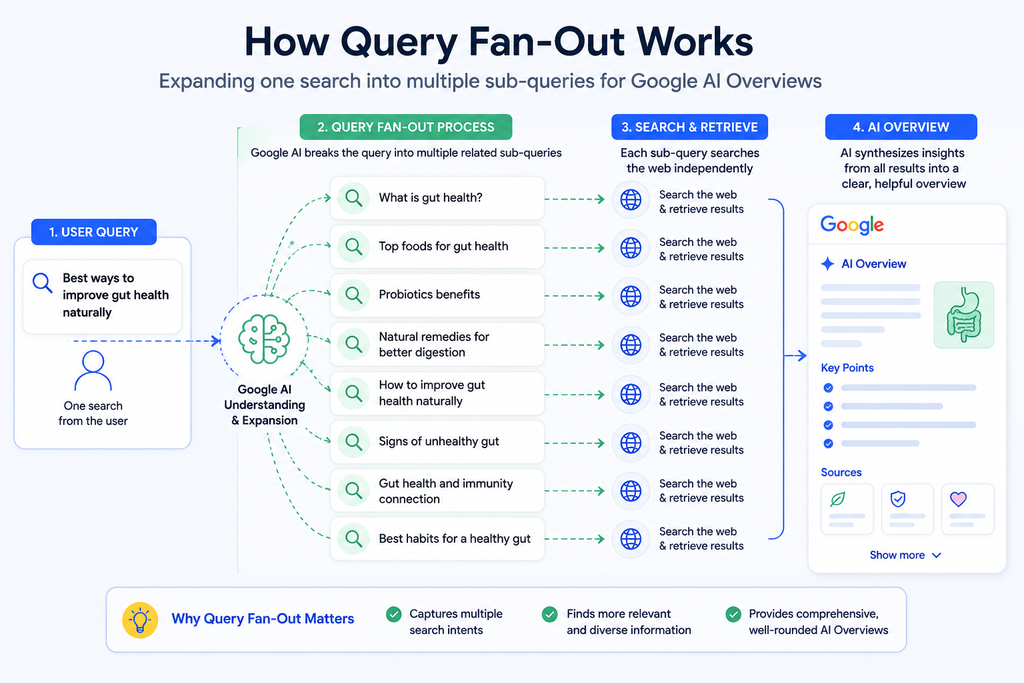
Google’s own example: a search for how to fix a lawn full of weeds fans out into sub-queries like best herbicides for lawns, removing weeds without chemicals, and preventing weeds in lawn. Different passages from different sources get pulled for each one.
Two practical consequences follow. First, your page can be cited for queries you never targeted, as long as it covers the topic with enough breadth. Second, depth of coverage now beats narrow keyword precision. An analysis of 10,000 keywords by Surfer SEO found a strong correlation, around 0.77, between how many fan-out queries a page ranked for and its likelihood of being cited.
Google also cautions against the obvious overreaction. Do not build a separate page for every query variation. That creates overlapping pages that compete with each other and waste editorial budget. Cover the sub-questions within strong pages instead.
The Tension Nobody Talks About
Here is where honest analysis matters, because there is a real conflict between Google’s official line and the field data.
Google says AI Overviews run on core Search systems, which implies your rankings should carry over. But Ahrefs’ March 2026 analysis of a large citation dataset found that AI Overview citations from pages ranking in the organic top 10 had fallen from around 76% in mid 2025 to roughly 38% by March 2026. In other words, the majority of citations now come from pages that do not rank on page one.
Both things can be true at once. Same index, same quality systems, but a retrieval process that evaluates passages against a fan-out of sub-questions rather than promoting the ranked list. A page sitting at position fourteen with a perfectly clear answer to one sub-question can beat a page at position two that buries it.
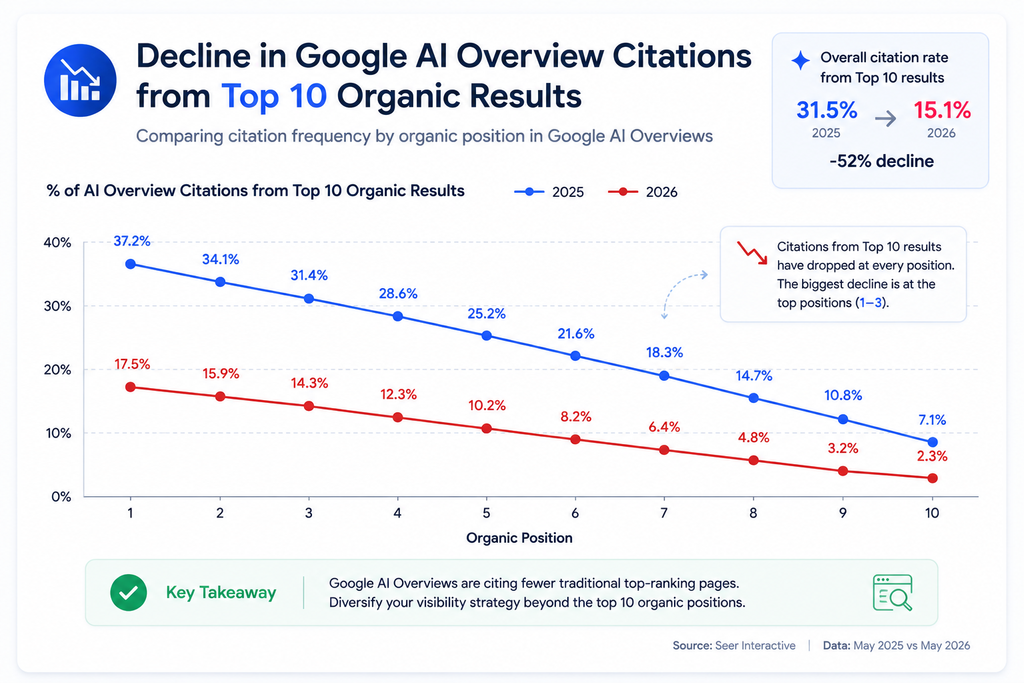
The practical takeaway: strong rankings remain the most reliable foundation, but they are no longer close to sufficient. We covered this wider split in AI SEO vs SEO, and the pattern differs by platform, as our breakdown of how ChatGPT chooses websites shows.
What Google Says You Can Stop Doing
The most valuable part of Google’s guide is the section that dismisses tactics an entire industry has been selling.
- There is no special AI Overviews algorithm to game. No separate ranking system exists to optimise for.
- No special structured data is required for AI features. Schema remains worth implementing because it supports rich results in normal Search and helps Google understand your page, but it is not a dedicated AI Overviews lever.
- AEO and GEO are still SEO from Google’s perspective. Google explicitly addressed both terms and folded them back into standard search optimisation, while pointing readers to its guidance on evaluating third party SEO advice.
- Mass producing thin pages for every query variation is counterproductive. Google’s people first guidance still warns against content created primarily for search traffic and heavily automated content across many topics.
If an agency is selling you AI Overview optimisation as a separate product with proprietary tactics, that guide is worth reading before you sign.
How to Optimise for Google AI Overviews: 7 Practical Steps
1. Fix Eligibility First
Crawlable pages, indexed content, visible text that does not depend on heavy JavaScript, clean internal linking, no accidental noindex or nosnippet on pages you want quoted. Nothing downstream matters if this fails.
2. Answer the Question in the First Two Sentences
AI Overviews extract passages, not whole pages. Under each heading, state the answer directly, then explain underneath. Ask yourself whether a single paragraph, lifted out and shown alone, would still make complete sense. If it needs the paragraph above it to be understood, it is harder to cite.
3. Build for Fan-Out Coverage, Not Single Keywords
List the sub-questions a complete answer to your topic would require, then make sure your page or cluster genuinely covers them. Comparisons, costs, timelines, objections, edge cases. This is the single biggest content shift AI Overviews demand.
4. Get Your Heading Structure Right
Your H2 and H3 hierarchy tells the retrieval system where an answer begins and ends. Question shaped headings map naturally onto fan-out sub-queries. Our guide to header tags for SEO covers the structure that works.
5. Publish Something Only You Could Write
This is the one factor AI genuinely raises the stakes on. Original data, first hand experience, named methodology, real client numbers, expert commentary. When a system is synthesising from several sources, it needs a reason to attribute something specifically to you. Generic advice gives it none.
6. Keep Content Fresh
AI Overview citations shift far faster than rankings do, especially in fast moving sectors. A quarterly refresh on your most important pages is a reasonable baseline, updating statistics, examples and dates rather than rewriting from scratch.
7. Build Authority and Brand Mentions
Entity signals matter across every AI surface. Consistent brand mentions, credible coverage, and a clean, consistent description of your business across the web feed the trust layer. Authority backlinks still do real work here.
How to Measure Google AI Overviews Performance
Measurement improved significantly in 2026. Google announced Search Generative AI performance reporting in Search Console, designed to show impressions from generative features including AI Overviews and AI Mode, broken out by pages, countries, devices and dates. Availability has been rolling out to a subset of sites, so check whether your property has it yet. Our guide to Search Console properties covers getting your setup right first.
Alongside that, run the manual test. Take 20 to 30 queries your customers actually search, check monthly whether an AI Overview triggers and whether you are cited, and log the trend rather than reacting to single results.
Set expectations on traffic realistically. Seer Interactive’s study of informational queries found organic click through rate dropping sharply when an AI Overview was present, from roughly 1.76% to 0.61%. The counterweight is that being cited helps: research from The Digital Bloom found brands cited as AI Overview sources gained around 35% more organic clicks. Fewer clicks are available overall, and citations decide who gets the remaining ones.
What This Means for Your Business
Google AI Overviews SEO is not a separate discipline bolted onto your existing programme. It is the same foundation, pointed at passage level extraction instead of page level ranking, with far more weight on topical breadth, clear structure and genuinely original material.
The businesses winning here are not the ones who bought a GEO package. They are the ones whose technical foundations are clean, whose content answers the whole question rather than one keyword, and who publish things a summary engine has a reason to quote.
Start here this week: search five queries your customers use, note whether an AI Overview appears, and read which pages get cited. You will learn more from those five results than from any checklist.
If you would like a team to run this across Google AI search and the wider AI landscape, explore our SEO services, read our complete guide to AI SEO, or get in touch for an audit of your current AI search visibility.
Frequently Asked Questions
What is Google AI Overviews SEO?
Google AI Overviews SEO is the practice of making your pages eligible, extractable and trustworthy enough to be cited inside Google’s AI generated summaries. Google’s official position is that this is not a separate discipline, since AI Overviews run on the same core ranking and quality systems as regular Search.
Is there a separate algorithm for ranking in AI Overviews?
No. Google confirmed in its May 2026 generative AI optimisation guide that AI Overviews and AI Mode are rooted in core Search ranking and quality systems rather than running on a separate index or algorithm. There is no dedicated AI Overviews ranking system to optimise for.
Do I need special schema markup for Google AI Overviews?
No. Google states that no special structured data is required for its generative AI features. Structured data is still worth implementing because it supports standard rich results and helps Google understand your content, but it is not a dedicated AI Overviews tactic.
What is query fan-out in Google AI search?
Query fan-out is when Google expands a single search into multiple related sub-queries and retrieves content across all of them before generating an answer. Google’s example is a query about fixing a weedy lawn fanning out into sub-queries about herbicides, chemical free weed removal and weed prevention. It means your page can be cited for questions you never explicitly targeted.
Do I need to rank in the top 10 to appear in AI Overviews?
Not necessarily, and this has changed quickly. Ahrefs’ March 2026 analysis found the share of AI Overview citations coming from top 10 organic results had fallen from roughly 76% in mid 2025 to about 38%. Strong rankings remain the most reliable foundation, but a majority of citations now come from pages outside page one.
Is Google SGE the same as AI Overviews?
Yes, effectively. SGE stood for Search Generative Experience, the name used during the experimental phase before the feature was rolled out and renamed AI Overviews. Guides still written around SGE terminology are generally out of date.
Do AI Overviews reduce website traffic?
Usually yes on affected queries. Seer Interactive found organic click through rate falling from around 1.76% to 0.61% on informational queries where an AI Overview appeared. However, research from The Digital Bloom found brands cited as sources gained around 35% more organic clicks, so citation status largely determines who keeps the remaining traffic.
How do I track my AI Overviews performance?
Google announced Search Generative AI performance reporting in Search Console in June 2026, showing impressions from AI Overviews and AI Mode with dimensions such as pages, countries and devices, rolling out to a subset of sites. Supplement this with a manual monthly check of 20 to 30 customer queries, logging whether an AI Overview triggers and whether you are cited.

Amir Siddiqui is a Digital Marketing Expert and SEO Specialist with over 8 years of experience helping businesses grow through data-driven digital marketing strategies. As the Founder of Web Marlins Pvt. Ltd., his core expertise lies in Search Engine Optimization (SEO), including Technical SEO, Local SEO, AI SEO, and content strategy. He has helped businesses across India, the USA, and the UAE improve search rankings, increase organic traffic, and generate high-quality leads through sustainable, results-focused SEO solutions.