
Updated: September 25, 2026
There are many concepts and metrics in SEO that aren’t officially recognized by Google, but professionals across the world acknowledge and use them. One such metric is domain authority (DA).
In fact, it is one of the most widely used SEO metrics for evaluating the overall strength and credibility of a website in SERPs. It helps you understand how your website compares with competitors and how likely it is to perform well in search engine results.
In this blog post, we are going to explain what domain authority is, its importance, and how you can measure it.
Domain Authority (DA) – Overview
Domain Authority is a third-party SEO metric that estimates a website’s ranking potential relative to other sites. It is calculated on a scale of 1 to 100; the higher the score, the greater the chances of it dominating the rankings.
The score is influenced by a range of factors, including:
- Backlinks quality
- Quantity of referring domains
- Link diversity
It is essential to remember that domain authority is not an official ranking factor. Search engines like Google have never acknowledged DA as a part of their search algorithm. However, many professionals and SEO gurus still consider it a valuable metric for assessing a website’s strength.
That’s why you should treat it as a benchmark tool rather than a direct indicator of good rankings.
Importance of Domain Authority
Below, we have discussed some of the key reasons why DA is considered important.
- Better Competitive Analysis
DA provides you with a simple and quick way to compare your site’s strength and ranking potential with competitors. Analyzing the domain authority score of your competitors will help you understand how challenging it can be for you to outrank them in search results.
For example, if the top-ranking websites in your targeted industry have high domain authority scores, then this clearly means you will need top-notch content and a comprehensive SEO strategy to compete effectively.
Performing competitive analysis via DA also helps identify benchmark goals. Instead of manually guessing how much effort will be required, you can evaluate the authority gap between your website and competing domains and then create a plan accordingly.
- Smarter Link Building
Link building is a core part of SEO because backlinks are a confirmed Google ranking factor. However, it is also true that not every link carries the same value. Links from relevant, credible, and authoritative sources usually carry more SEO weight than the ones coming from irrelevant and low-quality websites.
So, DA can be used as one of several metrics when evaluating potential backlink opportunities. Checking the DA score before pursuing a backlink also helps you avoid wasting time on domains that are unlikely to offer meaningful SEO value.
As a result, your outreach approach becomes more focused, strategic, and effective.
- Measuring SEO Success
As mentioned earlier, domain authority is not a direct ranking factor. However, it can be used to measure your website’s SEO progress. Here’s how. As your site earns more high quality backlinks and strengthens its overall link profile, its DA score may increase over time.
As you regularly publish quality content, build backlinks, and enhance technical SEO, the domain authority may start gradually increasing over time.
This increase indicates that your strategy is on the right track. However, if the score is gradually decreasing, then this means you need to refine the SEO strategy to experience better results.
We are saying this again: you should never consider the domain authority factor alone to decide on SEO progress. Use it in combination with other metrics such as:
- Keywords
- Organic traffic
- Backlink growth
- Assessing Website Credibility
Last but not least, DA can serve as a quick benchmark for comparing the relative strength of websites’ link profiles. A higher score generally reflects a stronger backlink profile relative to other domains.
This makes domain authority useful in many situations beyond your own site. For instance:
- SEO professionals can use it to evaluate potential guest posting sites
- Businesses can assess prospective partners
- Marketers can analyze the strength of competitors
How to Check the Domain Authority of Any Website?
The most common yet simplest way to check the domain authority score of any website is by using specialized DA checkers. These are easily available online. Most of them are free, secure, and simple to use.
For this guide, we selected DA checker to demonstrate how you can check the DA score of any website. Here’s what it returned when we entered our own website:
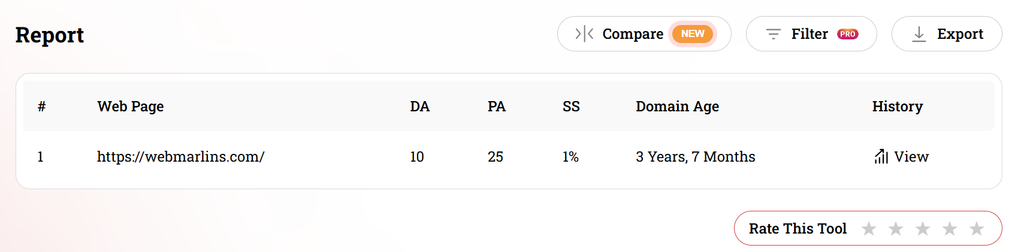
The tool not only calculates the domain authority score but also provides insights about page authority, spam score, domain age, and history.
What is a Good Domain Authority Score?
There is no exact answer to this question, as it depends on your targeted niche and the websites you are competing against. A DA score that is considered good in one niche may be considered average or even low in another.
For your understanding, below we have provided a general table:
| Domain Authority Score | Comment |
| 1 to 20 | Low |
| 21 to 40 | Average |
| 41 to 60 | Good |
| 60 or above | Excellent |
Bottom Line
Domain Authority is a third-party SEO metric used to compare the relative ranking potential of websites in the SERPs. It is measured on a scale of 1 to 100. Although it is not officially recognized by Google, it remains a commonly used benchmark among SEO professionals for assessing a website’s authority and comparing it with competitors.
In this blog post, we explain the DA score in detail, including its definition, importance, and how to check it. Hopefully, you will find this article genuine and helpful.

Amir Siddiqui is a Digital Marketing Expert and SEO Specialist with over 8 years of experience helping businesses grow through data-driven digital marketing strategies. As the Founder of Web Marlins Pvt. Ltd., his core expertise lies in Search Engine Optimization (SEO), including Technical SEO, Local SEO, AI SEO, and content strategy. He has helped businesses across India, the USA, and the UAE improve search rankings, increase organic traffic, and generate high-quality leads through sustainable, results-focused SEO solutions.